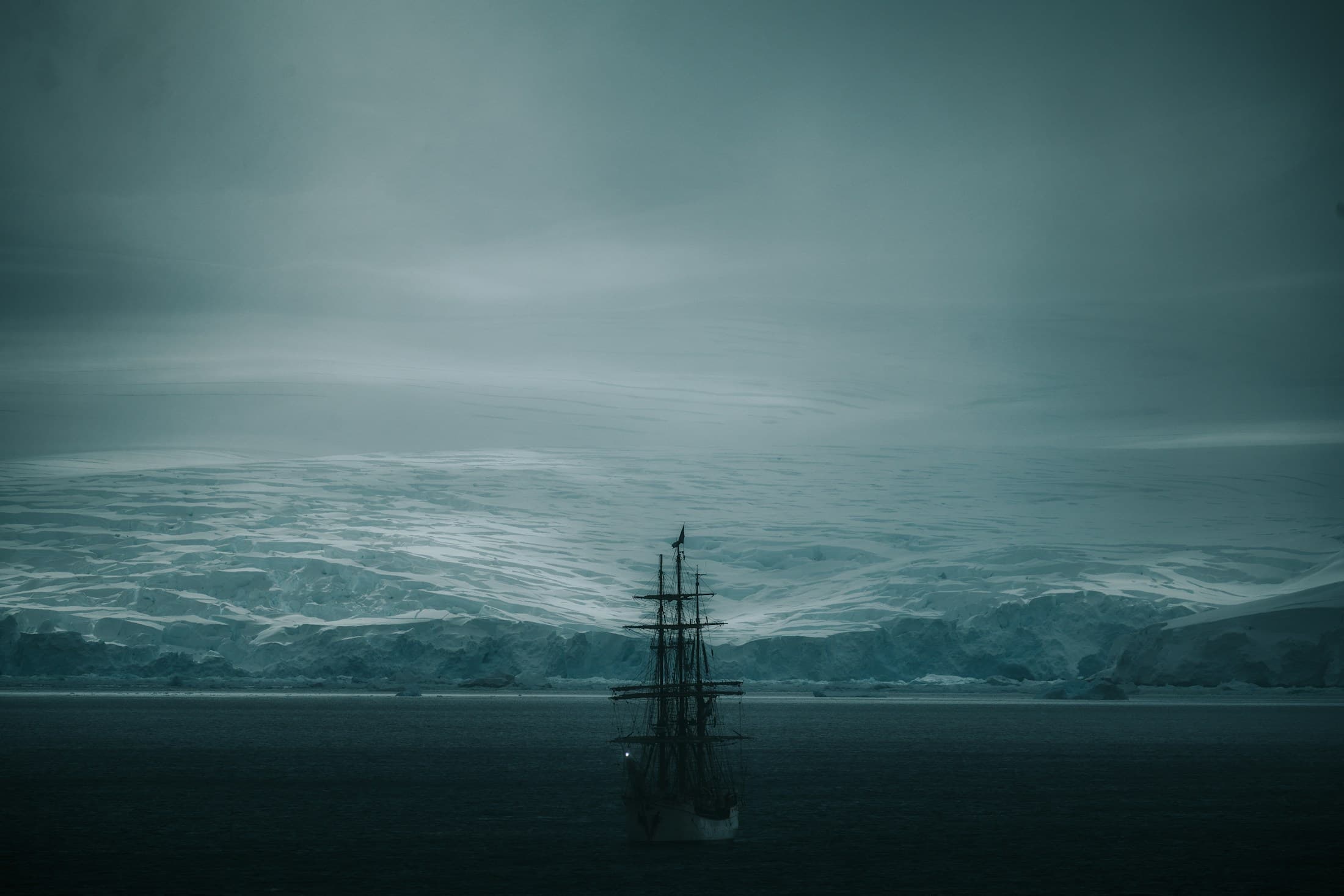
The polar regions represent the far edge of what a crewed yacht can offer: remoteness, wildlife on an entirely different scale, and a charter defined less by social calendars than by weather, ice, and judgement.
At the Edge of the Chart
Most yacht charters take place in climates that invite ease. Warm water, reliable provisioning, familiar logistics, and a social season that tells guests when to arrive and what to expect. The polar regions sit outside that logic. They are not an extension of Mediterranean or Caribbean chartering. They are a different proposition entirely: colder, slower, more technically demanding, and vastly more rewarding for guests who are genuinely interested in remoteness.
That distinction matters, because the Arctic should not be sold as an exotic variation on ordinary yachting. A high-latitude expedition is still a charter in the sense that service, privacy, and comfort matter. But its centre of gravity lies elsewhere. Ice conditions determine movement. Wildlife encounters happen on the environment's terms. Distances that appear short on a chart can become full-day decisions when weather, swell, or pack ice intervene. The pleasure of the trip is inseparable from that seriousness.
ADY arranges polar itineraries for guests who have already experienced the conventional charter world and want something fundamentally different: Svalbard for wildlife and ice-edge landscapes, northern Norway for fjords and marine life, and, in some cases, more ambitious expedition waters where vessel class and planning horizon become decisive. These programmes require realism, but for the right guest they offer one of the few remaining forms of travel that still feel genuinely exploratory.
Svalbard and the High Arctic
Svalbard is the clearest entry point to a true polar yacht experience in the Northern Hemisphere. From Longyearbyen, a capable vessel can work through a landscape of glacier fronts, walrus haul-outs, seabird cliffs, and broad ice-laden fjords unlike anything farther south. The quality of the light alone is difficult to describe to those who have not seen it: an Arctic clarity that makes scale feel unstable and distances hard to judge.
Wildlife is one of the reasons guests come, but it should be understood properly. Polar bears are possible rather than guaranteed on any given day, and good operators do not treat sightings as entertainment. The real privilege is being in terrain where such encounters are plausible at all. Walrus, seals, reindeer, and vast bird colonies are more consistent, and for photographers or naturalists the density of life in the short Arctic summer can be extraordinary.
The season is narrow. Late June through early September is the practical window for most yacht operations, with route choice dependent on ice distribution in a given year. The further east and north one wishes to go, the more the vessel's class, crew experience, and flexibility matter.
Northern Norway and the Human Edge of the Arctic
Northern Norway offers a slightly different experience and suits some guests better. Lofoten, Vesterålen, Troms, and the long fjord country combine dramatic scenery with settled communities, excellent seafood, and a maritime culture that remains visibly alive. One can still feel far north without being in a purely expeditionary setting.
This region rewards guests who want a mixture of wilderness and civilisation: fishing villages under steep mountains, passages through narrow sounds, long Nordic evenings, and, depending on the season, whales, birdlife, or even the first return of the northern lights. The autumn and winter whale season around Andfjorden and nearby areas can be especially compelling for guests willing to accept cold and reduced daylight in exchange for a very different marine spectacle.
Operationally, Norway can also be a sensible introduction to higher-latitude chartering because the infrastructure is stronger and the range of vessel options broader than in more extreme expedition waters. It remains serious boating, but not every day feels as remote as Svalbard.
What the Yacht Must Be
Vessel selection is the decisive question. Not every luxury yacht, however impressive its interior, belongs in polar waters. For Svalbard and other genuine Arctic environments, the yacht must have the right classification, the right safety equipment, the right tender setup, and a captain who is not merely willing to go north but accustomed to operating there. Ice-reinforcement, thermal systems, deck handling, navigation electronics, immersion protocols, and emergency readiness all move from background detail to central planning criteria.
This is one reason we work with a narrow group of expedition-capable vessels rather than trying to fit any available yacht to a polar brief. The success of the trip depends less on decorative luxury than on competence. Guests feel that difference quickly. A properly selected yacht makes the environment feel accessible without trivialising it.
We also recommend specialist guide support for most programmes. In Svalbard, this is often functionally essential as well as enriching. A serious naturalist or polar guide changes how the landscape is interpreted, how landings are conducted, and how wildlife is approached. Done well, this keeps the trip from becoming a sequence of cold-weather photographs with no depth behind them.
How We Prepare Guests
Polar guests need a more honest briefing than Mediterranean charterers. Clothing, expectations, wildlife rules, landing protocols, motion tolerance, and the possibility of route changes all need to be discussed before departure. The point is not to alarm people. It is to ensure they arrive ready for the trip they actually want rather than the fantasy version of it.
We plan these charters around priorities. Some guests want photography above all. Some care most about wildlife. Some want the architecture of ice and the physical sensation of being remote. Others want to combine expeditionary days with the privacy and service standard that only a yacht provides. Those distinctions shape the itinerary far more than a fixed notion of what an Arctic trip should look like.
When it works, the reward is unlike that of any warm-water charter. One remembers silence, scale, weather, and the concentration the environment demands. A polar passage is not about escaping the world. It is about reaching one of the few remaining parts of it that still resists simplification.