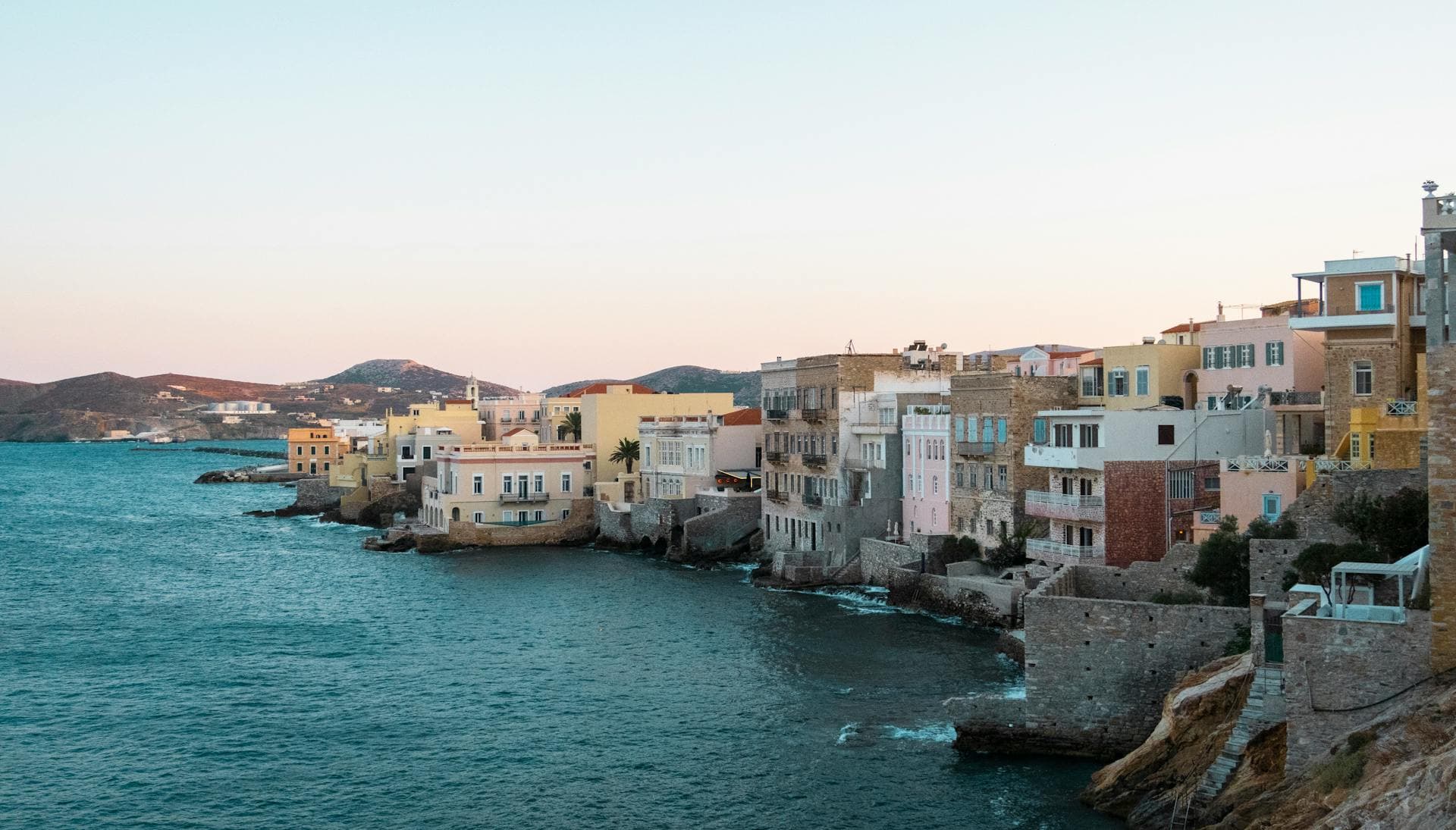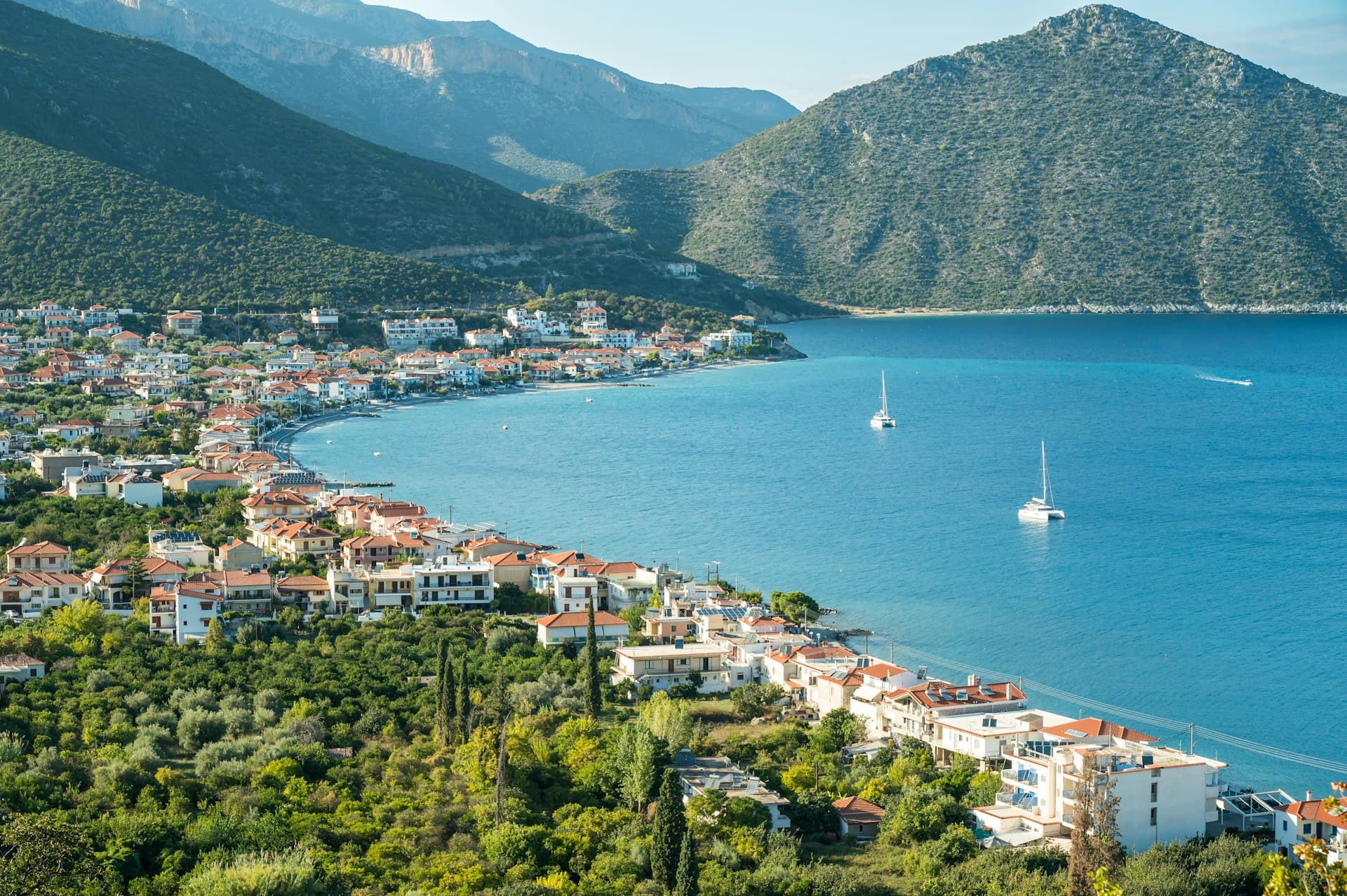
The Dodecanese are the southeastern frontier of the Greek islands — closer to Turkey than to Athens, with a character shaped by Byzantine, Crusader, and Ottoman history. This 205-nm route links seven islands between Rhodes and Kalymnos, combining UNESCO-listed medieval architecture, an active volcano, some of the clearest water in the Aegean, and a quieter cruising ground than the Cyclades.
Your VoyageRhodes to —
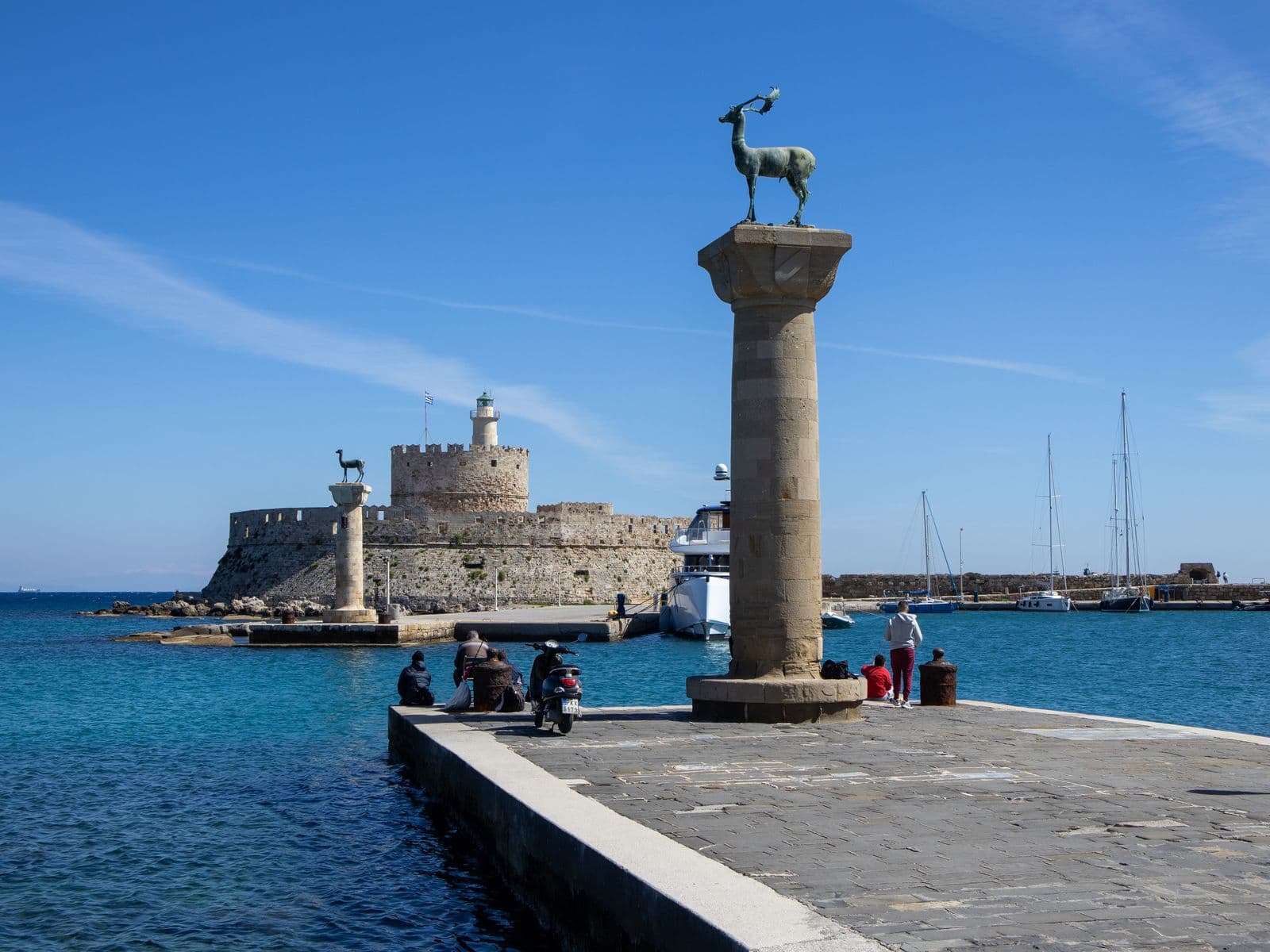
Embarkation in Rhodes and a full day to explore the medieval Old Town — a UNESCO World Heritage Site and one of the best-preserved medieval cities in Europe. The fortifications were built by the Knights of St. John (Order of Hospitallers) in the 14th–15th centuries. The Palace of the Grand Masters, the Street of the Knights, and the commercial quarter are all within the walls. Outside the Old Town, the Acropolis of Lindos (45 minutes south) is among the most spectacular ancient sites in Greece, perched above a bay.
Accuracy note: The Colossus of Rhodes — one of the Seven Wonders of the Ancient World — stood near the harbour but its exact location and posture are unknown. The popular image of it straddling the harbour entrance is a medieval invention not supported by historical evidence. The statue was toppled by an earthquake circa 226 BCE.
Rhodes to Symi
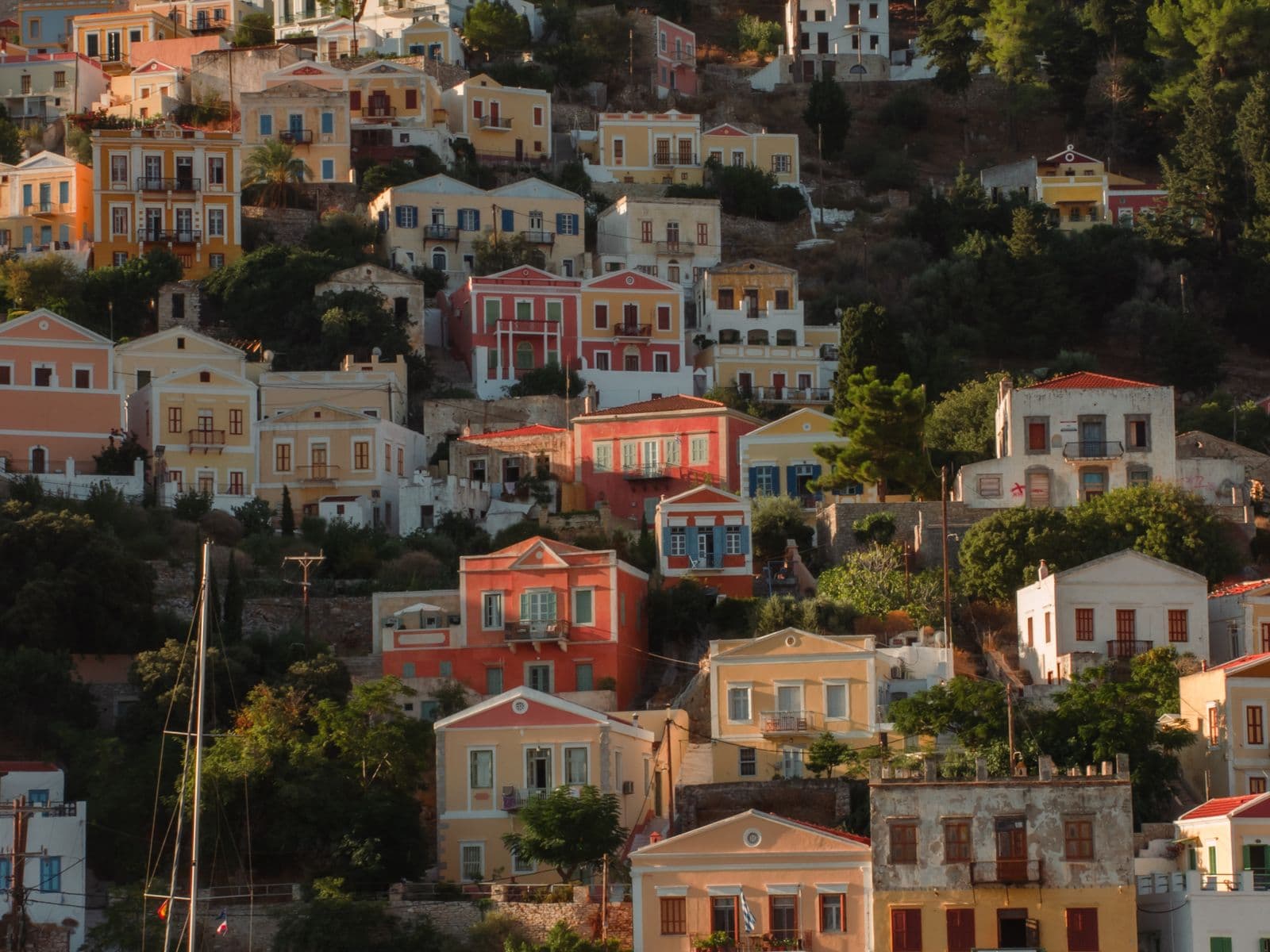
Thirty-two nautical miles north to one of the most photogenic harbours in Greece. Symi's neoclassical mansions — built during the island's 19th-century sponge-trading prosperity — rise in tiers of ochre, terracotta, and faded pastels around a deep harbour. The Panormitis Monastery on the south coast is a significant pilgrimage site. Symi is small and relatively quiet; the main settlement is compact enough to explore on foot in half a day.
Symi to Tilos
Thirty-one nautical miles west to Tilos, one of the least-visited islands in the Dodecanese. The island was the site of one of the most significant palaeontological discoveries in Greece — dwarf elephant fossils dating to 45,000 BCE, found in a cave near the village of Megalo Chorio. Tilos has been declared an ecological park, and its birdlife is notable. The main harbour at Livadia is quiet and well-protected.
Tilos to Nisyros
Twenty nautical miles to the volcanic island of Nisyros. The main attraction is the Stefanos crater — a still-active volcanic caldera that can be visited on foot, with sulphurous fumaroles, boiling mud, and a lunar landscape. The crater is 260 metres in diameter. The main town of Mandraki, on the north coast, has a Venetian castle and black-pebble beaches. Nisyros feels genuinely different from the rest of the Dodecanese — volcanic, fertile, and sparsely touristed.
Nisyros to Kos
Thirty-four nautical miles to Kos, the third-largest island in the Dodecanese. Kos Town has a well-preserved Crusader castle (Castle of the Knights), the ancient Asklepieion (a major healing sanctuary and training ground for physicians, associated with Hippocrates), and a tree in the main square traditionally identified as the Plane Tree of Hippocrates — under which Hippocrates is said to have taught. The Turkish coast and Bodrum are visible across the strait (only 4 nm). Kos has excellent beaches, a lively harbour front, and good provisioning.
Kos to Leros
Thirty-two nautical miles north to Leros, a green and hilly island with deep natural bays. Lakki, on the southwest coast, has one of the largest natural harbours in the Mediterranean and a distinctive Art Deco architecture from the Italian occupation period (1912–1943). The hilltop Castle of Panagia above the main town of Platanos offers panoramic views across the island. Leros is quieter than Kos and has a strong local character.
Leros to Kalymnos
Twenty-eight nautical miles to Kalymnos, historically the centre of the Greek sponge-diving industry. The island has reinvented itself in recent decades as one of the world's premier rock-climbing destinations — its limestone cliffs attract climbers from across Europe. The harbour at Pothia is colourful and busy. The Sponge-Diving Museum and the remaining sponge workshops are worth visiting. From Kalymnos, the return to Rhodes is 28 nm.
Kalymnos to Rhodes
Return passage to Rhodes for disembarkation. Alternatively, disembarkation can be arranged in Kos if more convenient for onward travel.
Season
May through October. The Dodecanese are further south and east than the Cyclades, with generally milder Meltemi conditions, though the channel between Kos and Bodrum can funnel wind. Water temperatures are among the warmest in Greece.
Embarkation
Rhodes has a well-equipped marina (Rhodes Marina) and good international air connections. Kos is an alternative embarkation/disembarkation point with its own international airport.
Provisioning
Full provisioning in Rhodes. Kos is well-stocked. Smaller islands (Tilos, Nisyros, Leros) have basic provisions only.
Turkey crossing
From Kos, a day trip to Bodrum (Turkey) is possible — approximately 4 nm across the strait. Immigration/customs formalities are required; discuss logistics with your captain in advance.
This itinerary is a suggestion.
Your captain will adapt the route based on weather, wind conditions, and your preferences. Patmos (with its UNESCO-listed Monastery of St. John) is a natural extension northward from Leros.
| Day | From | To | NM | |
|---|---|---|---|---|
| 1 | Rhodes | → | — | — |
| 2 | Rhodes | → | Symi | 32 |
| 3 | Symi | → | Tilos | 31 |
| 4 | Tilos | → | Nisyros | 20 |
| 5 | Nisyros | → | Kos | 34 |
| 6 | Kos | → | Leros | 32 |
| 7 | Leros | → | Kalymnos | 28 |
| 8 | Kalymnos | → | Rhodes | 28 |
| Total | 205 | |||